

The client with twelve features
A founder shows up with a shared Notion. Twelve features, written over two evenings on a digital pen. He wants to know how long and how much. I tell him: we'll get there, but first two hours with your team and the salesperson who actually talks to customers.
Two hours later, we walked out with four features dropped (not his problem, it was a guess), four simplified (over-engineered), four kept, and a fifth one that wasn't on the list. The real pain his customers had, which he uncovered the moment we asked the right question.
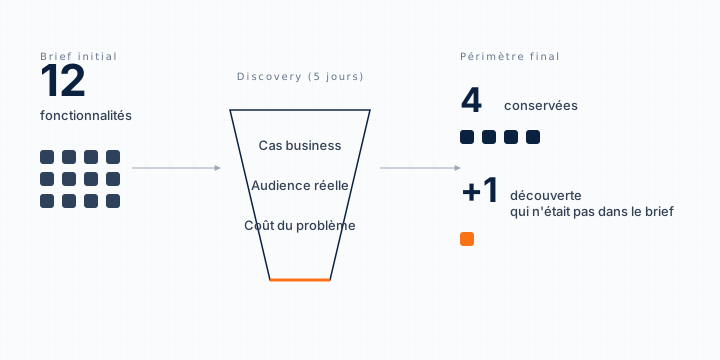
If we'd started by quoting his original backlog, we'd have shipped a technically clean product that missed the market. That happens to a lot of people. It's exactly why we never skip Sprint Zero.
The brief is never the brief
The brief you write before talking to us is a hypothesis. That's fine. You don't yet know what you don't know. Our job during Sprint Zero is to turn that hypothesis into something we can build with confidence.
We ask the questions most agencies skip because they don't like the answers. Three examples:
- How much is this problem costing you today? If you can't put a number on it, the problem isn't ripe. Better to find out now than six months in.
- Who on your team loses something if this product exists? Every internal product creates losers. Ignore them and they'll quietly sabotage adoption.
- If we shipped this tomorrow, what wouldn't work? This one surfaces more risk in five minutes than three days of workshops.
Five days, five deliverables
Our Sprint Zero fits in five days. No 80-slide deck. Five short, operational deliverables:
- Audience map. Who pays, who uses, who decides. Not a stock-photo persona, but actual interviews with three to five real people.
- Business case in numbers. Cost of the problem today, expected gain, time window. Three numbers max.
- Minimum viable scope. What we build, what we don't, and why. The list of "nos" matters more than the list of "yeses."
- Technical and regulatory constraints. The existing stack, mandatory integrations, GDPR where relevant. No surprises in month three.
- Launch plan. How this product reaches real users, and how we'll know it's working.
Five pages total. Readable in fifteen minutes. Decidable in an hour.
The question that changes everything
There's one we always ask, halfway through the second hour. It rattles people, and that's the point:
If I gave you a check that solved this problem without building any software, would you take it?
If the answer is yes, software isn't the right answer. You need a process, a consultant, a partnership. Not us.
If the answer is no, because you want an asset that you own, that scales without you, that becomes a competitive advantage, then we have something to talk about. And by then, Sprint Zero has already paid for itself in clarity.
Why most agencies skip this
Most agencies take the brief at face value. Not out of laziness, but because of business model. They sell time, and spending five days challenging the brief shrinks the billable scope. It's rational. It's also why we don't sell ourselves as an agency.
We lose projects sometimes because of Sprint Zero. The client realizes they didn't need the product they were about to buy. We'd rather lose like that than ship something we didn't believe in.
What it changes for you
A Sprint Zero costs a fraction of what going the wrong way for six months costs. Across the last twenty projects we've framed:
- One in four had its scope cut by more than 30% between the initial brief and the final scope.
- One in six uncovered a critical feature missing from the brief.
- Two of the twenty were dropped after framing. And that's a win for the client, not a loss for us.
The cheapest code is the code we don't write.
If you want to try it
If you have a project starting or an existing product that's stalling, a thirty-minute call is enough to see whether Sprint Zero makes sense for you. No slides, no pitch: we ask the three middle questions and tell you honestly what we think.